
9. Pairing Olive Oil with Food

Updated: Aug 12
Finding Great Olive Oil
Finding great olive oil usually means getting as close to the source as possible, and tasting.
Visit producers. Taste different oils side by side. And don't be afraid to use a guide. Yes, olive oil guides exist! In Italy, publications such as Slow Food's Guida agli Extravergini (in Italian) can introduce you to outstanding producers and help you discover where some of the country's best extra virgin olive oils are being made.
But I have another little test.
I judge restaurants by the olive oil they put on the table.
In Italy, restaurants cannot simply keep refilling an olive oil bottle. Bottles served at the table must have a tamper-resistant closure designed to prevent them from being refilled with a cheaper or inferior oil.
And yet, whenever a bottle arrives, I still smell the oil.
If it smells tired or rancid, I ask for another one.
If they don't have a good one?
Frankly, I begin to worry about the meal.
Because olive oil isn't a condiment sitting on the table as decoration.

It's an ingredient.
If a restaurant cares deeply about its tomatoes, its vegetables, its fish, its meat and its bread—but pours poor-quality olive oil over them—something doesn't add up.
Fortunately, you can also encounter the complete opposite.
I've eaten in wonderful restaurants where several extra virgin olive oils are brought to the table, each chosen for a different dish. Some restaurants even have an olive oil menu.
And this is where things become really interesting.
Because just as the right wine can completely change the experience of a dish, so can the right extra virgin olive oil.
A delicate oil over fish.
A grassy, bitter oil with vegetables.
A powerful, peppery oil over grilled meat or beans.
Suddenly olive oil isn't simply something you pour over food.
It's something you pair with it.
And that's where we're going next.
Think Like Wine
Most wine lovers would never serve a powerful Brunello with delicate oysters.
Nor would they serve a light Pinot Grigio with a charcoal-grilled steak.
We naturally match the intensity of the wine to the food.
Olive oil works exactly the same way.
A bold, peppery Tuscan oil can completely overwhelm delicate fish.
A soft, buttery olive oil might disappear on a grilled rib-eye.
Neither oil is wrong.
It's simply the wrong match.
The secret is matching intensity.
There are no absolute rules, of course. But a useful place to start is to think of olive oils in three broad styles; Mild / Medium / Robust.
Mild Olive Oils
Gentle.
Elegant.
Soft.
Often lower in bitterness and pepperiness.
Perfect with:
🐟 White fish
🥚 Eggs
🥔 Mashed potatoes
🧀 Fresh mozzarella
🥗 Delicate salads
🐔 Chicken
Fresh ricotta
Young cheeses
Their job is to support.
Not dominate.
Medium Olive Oils
The all-rounders.
Perfect for everyday cooking.
Wonderful with:
🍝 Pasta
🥬 Vegetable soups
🍄 Mushrooms
🐟 Salmon
Roasted vegetables
Chicken
Risotto
They're incredibly versatile.
Robust Olive Oils
Now we're entering Tuscany.
These oils are often intensely green, bitter and peppery—and many Tuscan oils naturally fall into this more assertive style.
Peppery.
Herbaceous.
Often intensely green.
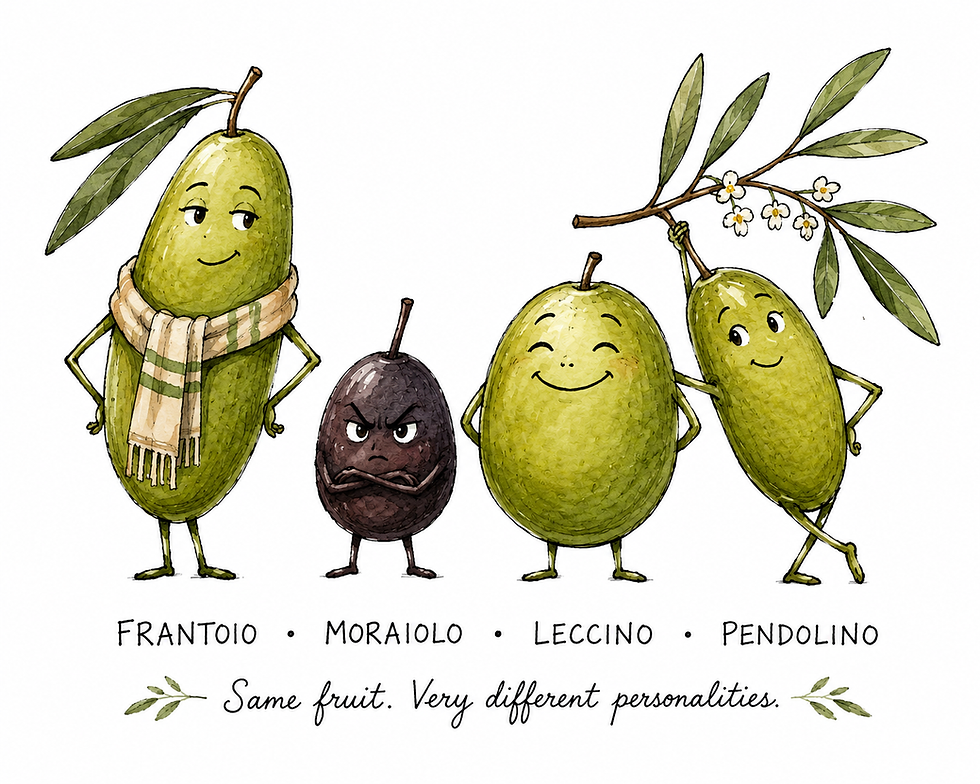
This is where varieties such as Frantoio and particularly Moraiolo can really shine.
They love bold food.
🥩 Bistecca alla Fiorentina (Tbone steak)
🥩 Grilled lamb
🍲 Bean soups
🥬 Ribollita
🥩 Game
The stronger the food...
the stronger the olive oil can be.
Tomato Loves Tomato
One of my favourite pairings is also one of the simplest.
A fresh tomato salad.
Cut into a ripe tomato and you'll find fresh, green, leafy aromas that can beautifully echo those in a young Tuscan olive oil.
Tomato leaf.
Fresh herbs.
Green aromas.
It's why the two can seem to amplify one another.
Sometimes the best pairing isn't contrast.
It's echo.
Pepper Meets Pepper
Fresh rocket (arugula).
Black pepper.
Radicchio.
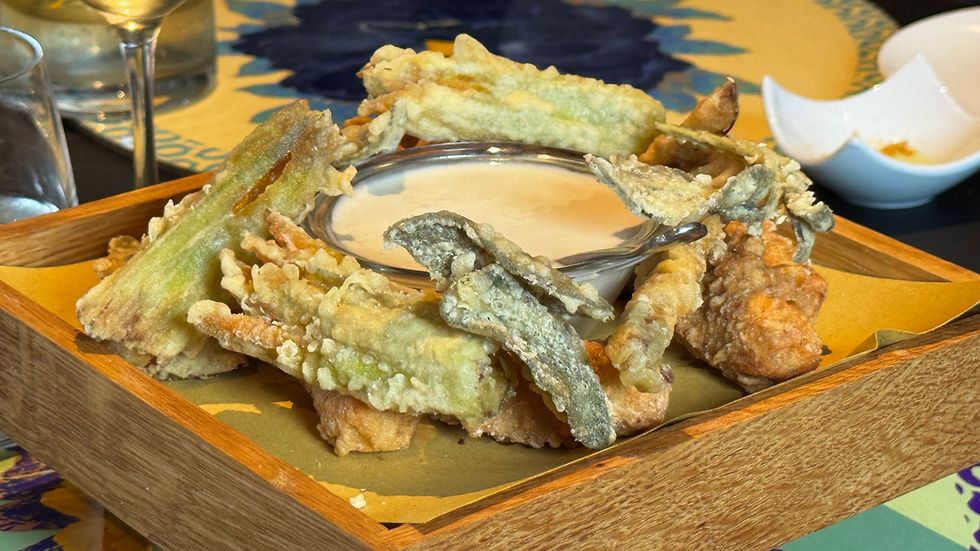
Artichokes.
These slightly bitter vegetables become wonderful partners for robust olive oils.
The bitterness doesn't necessarily clash.
It can reinforce the flavours already in the food.
Sometimes intensity loves intensity.
Sweet and Peppery?
This is where many people become nervous.
Olive oil...
with dessert?
Absolutely.
Good vanilla gelato finished with fresh extra virgin olive oil is one of those combinations that sounds strange—until you taste it.
The fruitiness and pepperiness cut through the sweetness beautifully.
Dark chocolate also works surprisingly well.
As does white chocolate.
Bread Is Not the Goal
Bread is perhaps the simplest way to experience a great olive oil.
And in Tuscany, when the new oil arrives, fettunta—toasted bread rubbed with garlic and drenched in fresh olive oil—is practically a celebration of the harvest.
But bread is only the beginning.
Great olive oil belongs on vegetables, beans, soups, meat, fish, pasta, cheese—and, as we've just discovered, even dessert.
Think of bread as the introduction.
The rest of the meal is where the fun begins.
Finish, Don't Hide
One of the most important things to understand about great olive oil is this:
You don't only cook with it.
You finish dishes with it.
That final drizzle over soup.
Grilled vegetables.
Steak.
Pasta.
Bruschetta.
Pizza.
It isn't decoration.
It's the final seasoning.
Just as you might add freshly cracked black pepper at the end...
great chefs often reach for olive oil.
Italians often call this adding oil a crudo—raw, after cooking.
Experiment
One of the nicest exercises you can try at home is incredibly simple.
Buy two completely different olive oils.
A delicate one.
And a bold Tuscan one.
Now try both on:
Fresh mozzarella.
Tomatoes.
Grilled vegetables.
Steak.
Vanilla ice cream.
You'll quickly discover that neither oil wins every time.
The food decides.
A Personal Note
One of my favourite moments at Campo Sasso happens every November.
Pierre and I open the first bottle of our freshly milled Olio del Campo.
No elaborate meal.
No special occasion.
Just toasted Tuscan bread still warm from the oven.
A pinch of sea salt.
And enough fresh olive oil to make the bread almost disappear beneath it.
It's ridiculously simple.
But every year it reminds us why we spend an entire year caring for those olive trees.
Not because olive oil is complicated.
Because, at its best, it makes simple food unforgettable.

Final Thoughts
People often ask me what food pairs best with Tuscan olive oil.
The truth is...
almost everything.
The real question is which Tuscan olive oil.
Just as wine has different grape varieties, regions and styles, olive oil has different personalities.
Some whisper.
Some shout.
The pleasure comes from finding the one that lets your food shine just a little brighter.
Once you start thinking of olive oil as a seasoning instead of simply an ingredient, you'll begin reaching for different bottles for different meals.
And that's the moment olive oil becomes every bit as fascinating as wine.


Comments