
10. Olive Oil Myths You Can Finally Forget

We've reached the last chapter of our olive oil series—at least for now! 😉
And I thought we'd finish by clearing up some of the myths surrounding olive oil.
Because for something so many of us use every day, olive oil is remarkably misunderstood.
Over the years, I've heard just about everything.
The greener the oil, the better.
Never cook with extra virgin olive oil.
Cloudy means artisanal.
And if it makes you cough...
...something has probably gone wrong.
After more than 30 years in Tuscany, and eventually becoming a certified olive oil taster through ONAOO, I've learned that olive oil is both simpler and far more fascinating than many of these statements suggest.
And I'm certainly not the only one who has wondered.
On our tours, I hear the same questions again and again.
So, for the final chapter...
let's bust a few olive oil myths.

Myth #1: You Should Never Cook with Extra Virgin Olive Oil
Perhaps the most widespread myth of them all.
People often imagine that heating extra virgin olive oil somehow destroys it instantly.
It doesn't.
In fact, people throughout Tuscany, and much of the Mediterranean, have cooked with extra virgin olive oil for centuries.
Good-quality extra virgin olive oil is remarkably stable during normal cooking thanks to its high proportion of monounsaturated fats and natural antioxidants.
Whether you're sautéing vegetables, roasting potatoes or making tomato sauce, extra virgin olive oil is perfectly at home.
(We explored this one in much greater detail in article 7 on cooking with extra virgin olive oil.)
Reality: Extra virgin olive oil isn't too precious to cook with.
It's what Tuscans cook with every day.
Myth #2: The Greener the Olive Oil, the Better It Is
This one surprises almost everyone.
During professional sensory evaluation, tasters deliberately avoid judging the colour.
That's why they use blue tasting glasses.
Colour depends on many things, including the olive variety, ripeness and chlorophyll content.
Some exceptional oils are bright green.
Others are beautifully golden.
Colour tells you surprisingly little about quality.
Your nose and palate tell you far more.
Reality: Judge olive oil by its aroma and flavour. Not its colour.

Myth #3: If Olive Oil Makes You Cough, Something Is Wrong
Quite the opposite.
That little peppery tickle at the back of your throat is often a sign you've just tasted a fresh olive oil rich in polyphenols.
Those natural compounds contribute much of the bitterness and pepperiness we associate with high-quality extra virgin olive oil.
Not every great oil makes you cough.
But many fresh Tuscan oils certainly can.
Reality: Sometimes a cough is actually a compliment to the producer.
Myth #4: "Extra Virgin" Means It's the Best Olive Oil You Can Buy
Not quite.
Extra Virgin is a legal quality category.
It tells you the oil has met specific chemical and sensory standards.
It doesn't tell you whether the olives were harvested early or late.
How fresh the oil is.
Whether it comes from exceptional fruit.
Or whether you'll actually enjoy its flavour.
Think of it as the starting line—not the finish line.
Reality: Every great olive oil is extra virgin. Not every extra virgin olive oil is great.
Myth #5: Cloudy Olive Oil Is Always Better
Freshly produced olive oil is often naturally cloudy because tiny particles of olive pulp and droplets of water remain suspended in the oil.
Some producers bottle it exactly like that.
Others filter it immediately.
Neither approach automatically produces better olive oil.
Filtering actually improves stability and shelf life, which is why many high-quality producers choose to do it.
Cloudiness isn't a guarantee of quality.
Freshness is.
Reality: Cloudy doesn't mean better. Clear doesn't mean worse.
Myth #6: Olive Oil Is a “Good Fat.” Butter Is a “Bad Fat.”
Nutrition loves simple labels.
Good fat.
Bad fat.
Unfortunately, our bodies—and our diets—are a little more complicated than that.
Extra virgin olive oil is rich in monounsaturated fatty acids, particularly oleic acid, and also contains minor compounds such as polyphenols.
Butter contains considerably more saturated fat.
That doesn't mean one spoonful is “good” and the other is “bad.”
What matters is the overall diet, how often we eat different fats, and what they're replacing.
Fat is also an essential part of our diet. We need it to absorb certain vitamins, build cell membranes and perform many normal biological functions.
So perhaps the better lesson isn't to fear fat—or give every fat a moral label.
It's to understand what we're eating.
Reality: Olive oil can be part of a healthy diet. Butter can be part of one too. Context matters.

Myth #7: The Best-Before Date Tells You How Fresh the Oil Is
A best-before date doesn't tell you when the olives were harvested.
That's an important distinction.
An oil can have plenty of time remaining before its best-before date without necessarily being from the most recent harvest.
When I'm choosing olive oil, I'm therefore much more interested in finding the harvest year on the label.
Not every bottle provides it.
But when it does, that's useful information.
That's why, when I'm choosing a bottle, I'm much more interested in finding the harvest information.
Olive oil doesn't suddenly “expire” on the best-before date.
But it does gradually lose the freshness, aromas, bitterness and pepperiness that make a young oil so exciting.
Reality: Don't just look at the best-before date. Look for the harvest year.
Myth #8: Expensive Olive Oil Is Always Better
Price tells you something.
But not everything.
Making exceptional olive oil is expensive.
Early harvesting means lower yields.
Rapid transport to the mill costs money.
Careful storage, dark bottles and certifications all add expense.
But none of that guarantees you'll prefer one bottle over another.
So while a high price doesn't guarantee exceptional olive oil, an unusually low price should make you ask questions. Producing genuinely high-quality extra virgin olive oil simply isn't cheap.
Reality: Price isn't a guarantee. Knowledge is a better guide.
Myth #9: Bitterness Is a Defect
If anything, pleasant bitterness is often one of the hallmarks of a fresh, high-quality extra virgin olive oil.
Its bitterness is associated with phenolic compounds naturally present in the oil.
The important word is pleasant.
Like the bitterness of good dark chocolate.
Distinctive.
Complex.
Sometimes surprisingly intense.
But part of the oil's character—not a defect.
Reality: Bitterness isn't the enemy. It's part of the character.
Myth #10: Olive Oil Is Just Olive Oil
This might be the biggest myth of all.
Imagine saying:
"Wine is just wine."
You already know it isn't.
The same is true of olive oil.
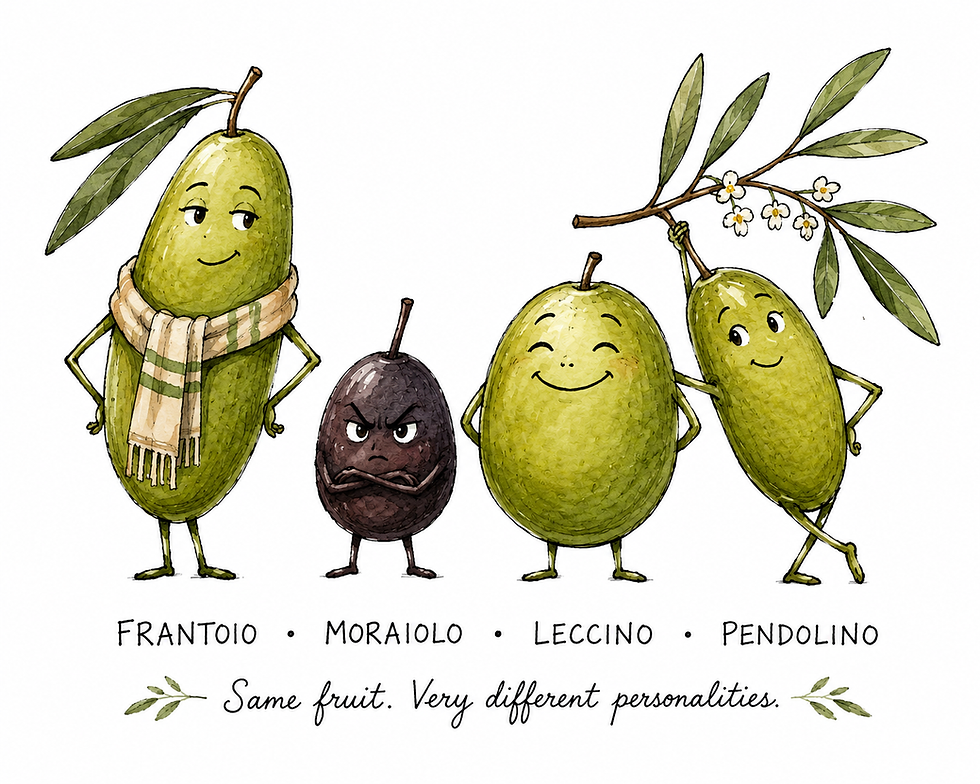
Different olive varieties.
Different climates.
Different harvest dates.
Different producers.
Different milling techniques.
Different philosophies.
Every decision shapes the final bottle.
That's why one olive oil can smell of tomato leaf and freshly cut grass, while another reminds you of ripe almonds and wild herbs.
The more you taste, the more you realise olive oil is every bit as diverse and fascinating as wine.
Reality: Olive oil has terroir, personality and stories worth discovering.
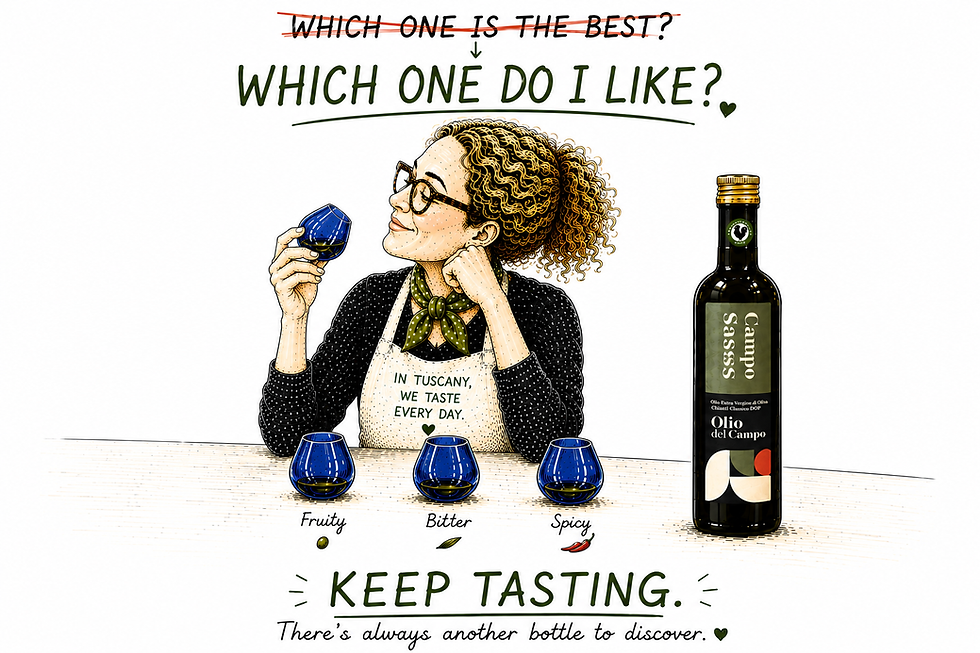
Final Thoughts
One of the things I love most about guiding olive oil tastings is watching people's expectations quietly change.
By the end of the tasting, they're no longer asking:
“Which olive oil is the best?”
Instead, they ask:
“Which one do I like?”
Because once the myths disappear, curiosity takes their place.
And that's exactly where the real enjoyment begins.
So keep tasting.
There's always another bottle to discover.
And that's exactly where the real enjoyment begins.

Comments