
6. How to Buy Great Olive Oil

Updated: Aug 12
(Even If You Know Nothing About Olive Oil)
"Standing in front of the olive oil shelf shouldn't feel like taking an exam."
Over the years I've watched thousands of guests taste extraordinary olive oils at the wineries we visit with Grape Tours.
Then, a day or two later, many of them stop by Formaggioteca Terroir in Florence.
They wander over to the olive oil shelf.
They pick up a bottle.
Turn it over.
Read the label.
Compare the price with the bottle beside it.
Sooner or later, they look up and ask:
"Rebecca... now that I've tasted great olive oil... how do I know which bottle to buy?"
I love that question.
Because by that point, the answer isn't nearly as complicated as they expect.
Unlike wine, olive oil labels rarely make things easy.
Every bottle proudly says Extra Virgin.
Some are organic.
Some carry a DOP or IGP certification.
Some cost €12.
Others three times as much.
So what actually matters?
After years of guiding olive oil tastings, and becoming a certified olive oil taster through ONAOO, I've realised something.
Buying great olive oil isn't really about learning the labels.
It's about understanding what makes a great olive oil in the first place.
And after reading the articles in this series...
...you're already well on your way.
Let's go shopping.
Rule One: Look for the Harvest Year
If I could choose only one thing to look for on an olive oil label, it wouldn't be "Extra Virgin."
It would be the harvest year, or vintage as we say in the wine world.
But olive oil isn't like wine.
It doesn't improve with age.
From the moment it's produced, it slowly begins losing the vibrant aromas and flavours that make fresh extra virgin olive oil so exciting.
Freshly cut grass.
Tomato leaf.
Artichoke.
That lovely peppery finish.
They all gradually fade with time.
Unfortunately, many bottles only display a best-before date, which can be misleading. Two bottles with the same best-before date may have been harvested months or years apart. In fact, the best-before date is usually calculated from the bottling date (typically 18 months), not from the harvest.
Whenever possible, choose an olive oil that proudly states the harvest year.
Freshness is one of the greatest luxuries in olive oil.
Why "Best Before" Doesn't Mean Much

One thing worth mentioning is that olive oil doesn't suddenly "expire" the day it reaches 18 months.
A well-made extra virgin olive oil that has been stored away from heat, light and air can often remain perfectly enjoyable for two, three or even four years.
The difference is freshness.
Over time, those beautiful aromas of freshly cut grass, tomato leaf, herbs and green almond gradually become softer and less expressive. The peppery finish slowly fades too.
Think of it like fresh bread.
A loaf that's a day old is still perfectly good.
It's just not quite as exciting as the day it came out of the oven.
Great olive oil ages in much the same way.
Rule Two: Know Where It Comes From
Imagine buying a bottle of wine that simply said:
"Wine from Europe."
You'd probably want a little more information.
Olive oil is no different.
Look for the origin of the olives.
Were they grown in one country?
Several countries?
On a single estate?
In a protected region?
The more specific the origin, the more transparent the producer is being.
Remember, every region produces a different style of olive oil.
Just as Tuscany doesn't taste like Sicily, neither tastes like Greece or Spain.
Origin isn't about one region being better than another.
It's about understanding the style you're buying.
Rule Three: Learn What DOP and IGP Mean
These little logos aren't there just to decorate the label.
DOP (Protected Designation of Origin) means every stage of production—from growing the olives to milling and bottling—takes place within a defined geographical area according to strict regulations.
IGP (Protected Geographical Indication) offers traceability too, but with slightly different rules.
Neither certification automatically guarantees you'll love the flavour.
But both offer reassurance about authenticity and origin.
They're part of the bottle's story.

Rule Four: Only dark bottles or tins
Dark glass isn't there because it looks elegant.
It's there because light is one of olive oil's greatest enemies.
Quality producers also use tins for the same reason.
Clear glass may look transparent on the shelf, but it allows light to damage the oil over time.
Once you've bought your bottle, treat it the same way.
Store it somewhere cool and dark, not beside the cooker or on a sunny windowsill.
Rule Five: Understand the Label
Modern olive oil labels are full of claims and certifications:
Cold extracted
Organic
Unfiltered
Stone ground
Some have a precise legal meaning.
Others tell you surprisingly little about quality.
Some are meaningful.
Some tell you surprisingly little about quality.
By now you already know that the most important words are still Extra Virgin, because they're legally defined.
Everything else is secondary.

Organic (or biologico in Italy) means the olives were grown without synthetic pesticides or herbicides. It doesn't automatically guarantee better flavour, but it does tell you something about how the olives were farmed—and for many people, that's an important consideration.
Rule Six: Price Matters... But Only Up to a Point
One of the questions I hear most often is:
"Can a cheap olive oil still be good?"
Rarely.
But it's worth remembering what goes into making great olive oil.
A year of caring for the trees.
Careful pruning.
Harvesting at exactly the right moment.
Often harvesting early, which means less oil with more flavour.
Getting the olives to the mill within hours.
Careful storage.
Dark bottles.
Sometimes an IGP or DOP certification.
All of that costs money.
An expensive bottle isn't automatically better.
But exceptionally good olive oil is never the cheapest bottle on the shelf.
Rule Seven: Trust Your Nose
Once you get home, don't pour the oil straight onto your food.
Open the bottle.
Take a moment to smell it.
Does it smell fresh?
Bright?
Green?
Alive?
Or does it smell flat and tired? Or even rancid (gosh, I hope not!)
Your nose will tell you far more than the front label ever could.
One of the nicest compliments I receive from guests is when they tell me they now smell every bottle before using it.
Mission accomplished.

Rule Eight: Buy the Producer, Not the Brand
This is the one lesson I hope you'll remember.
Whenever possible, buy from people.
From farmers.
Small producers.
Olive mills.
Specialist shops that know the story behind their bottles.
The best olive oils don't begin with clever marketing.
They begin with someone standing beneath an olive tree, looking up at the fruit, deciding exactly when it's ready to pick.
A Personal Note
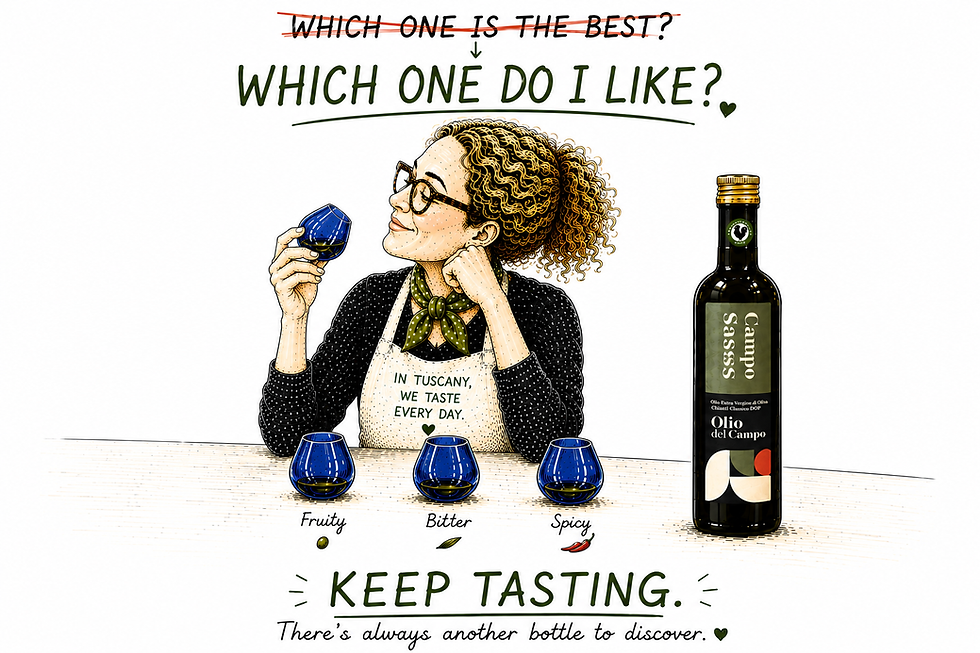
Many guests who ask me this question eventually leave Formaggioteca Terroir with a bottle of our own Olio del Campo from Campo Sasso.
Not because it's ours. But because by then they've already tasted it.
And, by that stage, they already understand why we made the choices we did.
Why we harvest early, even though it means producing less oil.
Why we rush our olives to the Pruneti olive mill within hours of picking them.
Why we store the oil carefully in stainless steel tanks before bottling.
Why we went through the process of obtaining DOP Chianti Classico certification.
In other words, they're no longer buying our olive oil because I recommended it.
They're buying it because they've learned how to recognise the kind of olive oil they enjoy.
That, to me, is the greatest satisfaction of all.

Final Thoughts
So... how do you actually choose a great olive oil?
It's all about knowing how good olive oil should be made and trusting the producer.
And that's really been the thread running through this entire guide.
Once you start noticing freshness instead of colour...
Harvest year instead of just a best-before date...
The producer instead of the packaging...
...you'll never really shop for olive oil in quite the same way again.
I hope that, the next time you pick up a bottle, you'll pause for just a moment and wonder about the people behind it.
Because somewhere, perhaps on a hillside here in Tuscany, someone spent an entire year making that bottle possible.
And if one day that bottle happens to be our Olio del Campo, I hope you'll taste not only the olive oil, but the story behind it too.

Comments