
No, the symbol of Florence is not a lily

Florentines may fall off their chairs when they hear this. But it’s true.
The famous “lily” or "fleur-de-lis" of Florence — the one stamped on the city’s coat of arms, flying on flags, printed on football scarves, and baked into desserts — is not a lily at all.
It’s an iris.
A case of mistaken identity (for centuries)
In Tuscany, you’ll often hear the flower called giaggiolo. Sometimes it’s casually referred to as a lily. But botanically, historically, and symbolically, Florence has always belonged to the iris.
This flower grows wild in the Arno Valley and on the hills surrounding the city. In fact, it’s said that in ancient times, the entire valley turned purple during flowering season in May — an almost unimaginable sea of blooms.
And if you know where to look, you can still find that magic today.
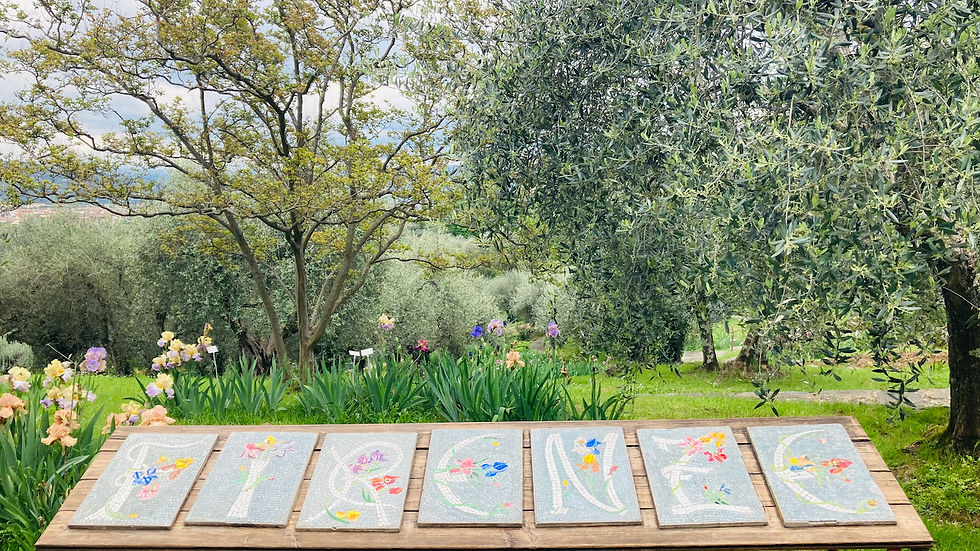
On the hill overlooking Piazzale Michelangelo, tucked just above the city, lies the Giardino dell'Iris — the only botanical garden in Europe dedicated entirely to this flower.
Founded in 1957, it’s also home to an annual international iris competition. Each spring, collectors and growers from around the world gather here to see which iris will be crowned the most beautiful. It's open from the 25th of April until May 20th - see more here.
You’ll find irises in countless shades, but the most emblematic are:
soft lavender (Iris pallida),
deep royal purple (Iris germanica),
and the elegant white, delicately veined with blue (Iris florentina), once common, now increasingly rare.
From flower to political symbol
The iris has been part of Florence’s identity since the Middle Ages.
Originally, the city’s emblem showed a white iris on a red background. But Florence, being Florence, politics soon got involved.
In 1266, after the victory of the Guelphs over the Ghibellines, the colors were reversed to red on white — a powerful visual statement of triumph. Dante himself references this change in the Divine Comedy, writing of “the lily made vermilion by division.”
From that moment on, the iris wasn’t just a flower. It became a declaration.
A Florentine obsession (in many forms)
Once you start noticing the iris, you see it everywhere.
In perfume and skincare
For centuries, Florence’s historic Officina Profumo-Farmaceutica di Santa Maria Novella has used iris in cosmetics and fragrances. The rhizomes (roots) are transformed into powders, extracts, and essential oils prized for their softening, soothing, and delicately perfumed qualities.
The scent is elegant, powdery, and unmistakably Florentine. See the perfume here.

In dessert form
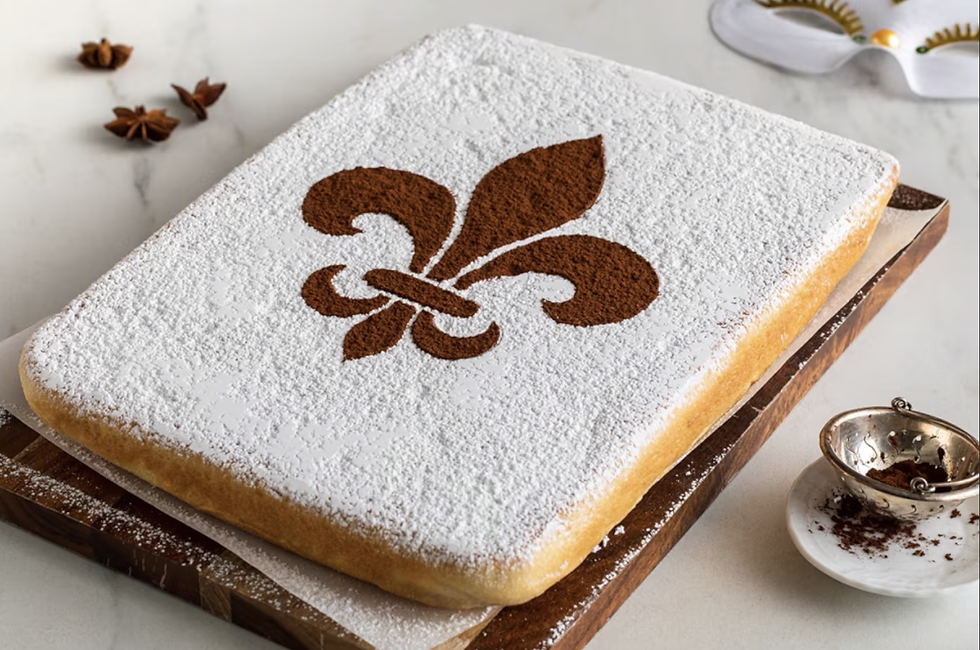
There may be no sweeter tribute than Schiacciata Fiorentina.
Traditionally a Carnival cake (though now enjoyed year-round), this soft, orange-scented cake is filled with cream and blanketed in powdered sugar. Before dusting the surface, pastry chefs place an iris-shaped stencil on top — leaving behind the unmistakable Florentine symbol.
It’s so beloved that there’s now an annual competition for the best version in the city. The most decorated winner? Caffè Gilli, in Piazza della Repubblica — best enjoyed slowly, with an espresso. And here's a recipe (use google translate) if you want to make it at home.
On the football pitch
And then there’s la Viola.
Florence’s football team, ACF Fiorentina, has worn purple jerseys since 1929 — viola, the color of the iris. The flower appears once again on the team’s crest, echoing the city’s emblem.
The team has known glory and disappointment, but the love Florentines have for it remains unwavering. Purple scarves, purple flags, purple heart
When the hills bloom
Each May, the story comes full circle in the hills south of Florence, in the Val d'Ema where Campo Sasso lies. In San Polo in Chianti, the Festa del Giaggiolo celebrates the iris with walks through blooming fields, music, markets, and activities for all ages.
It’s a reminder that this flower wasn’t just symbolic — it was once an important economic resource. Iris roots were cultivated and exported across Europe for cosmetics and medicine, shaping livelihoods throughout the Arno Valley.
A flower that is Florence
So no — the symbol of Florence is not a lily.
It’s an iris: political, poetic, practical, and deeply rooted in the land itself. A flower that tells the story of Florence better than any monument ever could.
Once you know, you’ll never unsee it.
By Ilaria Miele & Rebecca Christophersen Gouttenoire


Comments