
4. From Tree to Bottle: How Tuscan Olive Oil Is Made

Updated: Aug 12
Olive oil isn't made in a day. It's made over an entire year.
Spend a year living in the Tuscan countryside and you'll notice something curious.
There are moments when the olive groves seem almost forgotten.
Winter arrives, the harvest is over, and the trees stand quietly on the hillsides while everyone's attention shifts elsewhere.
Then, almost without warning, the cycle begins again.
Branches are pruned.
Tiny flowers appear.
Small green olives begin to grow.
Summer heat ripens the fruit.
And before long, tractors are once again winding their way through the countryside carrying crates of freshly picked olives towards the local mill.
Once the olives reach the mill, a bottle of extra virgin olive oil can be produced in just a few hours.
But in reality, it has been almost a year in the making.
Let's follow that journey.

Winter: Pruning for Next Year's Harvest
Once the olives have been picked, the trees are given time to rest.
Then, during late winter and early spring, growers begin pruning.
To anyone seeing it for the first time, it can look rather shocking.
Branches that took years to grow suddenly disappear.
Some trees seem almost naked.
I remember thinking exactly the same thing the first time I watched our neighbours pruning their olive trees.
"Surely that's too much?"
Apparently not.
Pruning isn't about making the tree look pretty.
It's about helping it produce better olives.
An open canopy allows sunlight to reach the centre of the tree while improving air circulation, making it harder for diseases to develop and easier for the fruit to ripen evenly.
Growers often compare it to giving the tree room to breathe.
And like vineyards, every producer has their own philosophy.
Some prune lightly.
Others much more aggressively.
The goal, however, is always the same:
Healthy trees.
Healthy olives.
Better olive oil.
Spring: Thousands of Flowers... But Only a Few Olives
As temperatures rise, olive trees burst into bloom.
The flowers are tiny.
Most visitors never even notice them.
Yet every tiny blossom carries the possibility of becoming an olive.
Well...
...not quite.
An olive tree produces astonishing numbers of flowers.
Only a small percentage will actually become fruit.
At first this seems incredibly wasteful.
Why produce thousands of flowers if only a fraction survive?
Nature is simply playing the odds.
Wind, rain, insects and changing weather all influence pollination, so the tree produces far more flowers than it could ever realistically support.
The successful ones begin developing into tiny green olives.
The rest quietly fall to the ground.

Early Summer: Tiny Olives, Big Decisions
By early summer the flowers have disappeared.
In their place are olives no bigger than peas.
Now the tree begins directing its energy into growing fruit.
At this stage, weather becomes increasingly important.
Too much rain can encourage disease.
Too little can stress the tree.
A hot, dry Tuscan summer may reduce the final crop, but it can also encourage the production of concentrated flavours and polyphenols.
Just as with wine, challenging growing seasons sometimes produce remarkable quality.

Summer: Slow Growth Under the Tuscan Sun
Through the long summer months, olives slowly increase in size. First the pit, then the flesh develops.
Unlike grapes, they don't suddenly swell with sugar.
Instead, oil gradually begins forming inside the fruit.
The tree is quietly storing the very thing that will eventually end up in your bottle.
Olive trees are remarkably resilient.
Many have survived for centuries.
Their deep root systems allow them to cope with drought far better than many other crops, which is one reason traditional Tuscan olive groves have rarely relied on irrigation.
Instead, growers spend the summer watching.
Waiting.
Hoping for just enough rain.
Not too much.
Not too little.
As every Tuscan farmer knows, agriculture is an exercise in patience.
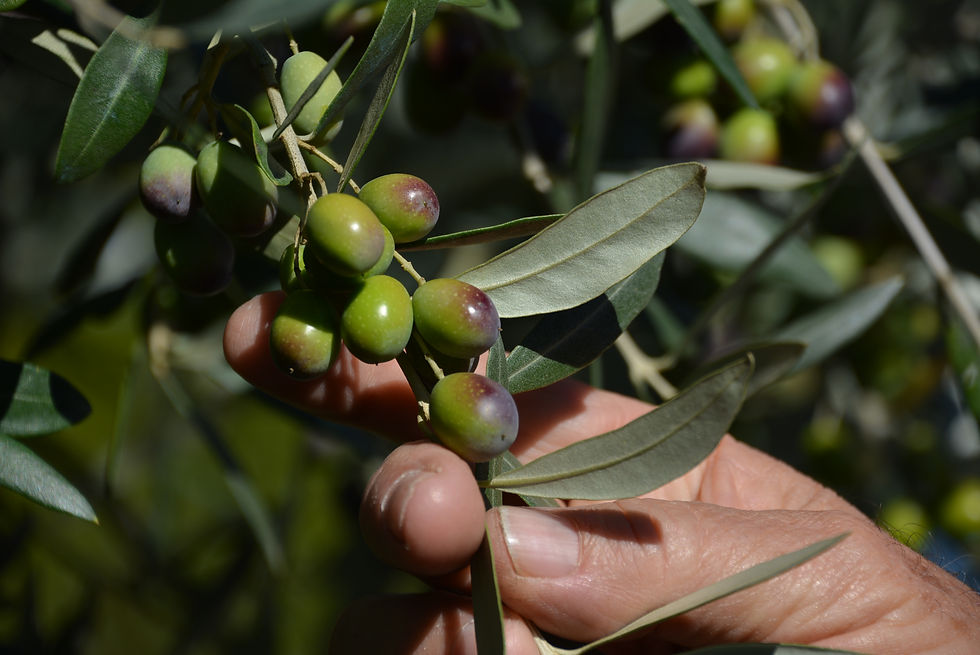
Late Summer: Olives Have Their Own Veraison Too
Wine lovers are often surprised to discover that olives undergo something remarkably similar to grapes.
It's called veraison.
During late summer and early autumn, olives gradually begin changing colour.
Bright green fruit slowly develops shades of purple before eventually becoming almost black.
The transformation isn't simply cosmetic.
Inside the olive, important chemical changes are taking place.
Oil content increases.
Meanwhile, chlorophyll slowly declines and other pigments begin to appear, changing the olive's colour.
Flavours evolve.
Polyphenol levels shift.
This is when one of the biggest decisions of the year approaches.
When should the harvest begin?

Autumn:
Harvest Finally Arrives
If you've ever visited Tuscany in October or November, you've probably seen it.
Large green nets spread beneath the trees.
Families working together.
Electric olive combs vibrating through the branches.
The occasional tractor making its way slowly along country roads, stacked high with crates of freshly picked olives.
Harvest season has begun.
Unlike wine grapes, olives aren't picked all at once across Tuscany.
Every producer chooses their own timing.
Some harvest early to produce intensely green, peppery oils rich in polyphenols.
Others wait longer, accepting slightly softer flavours in exchange for higher oil yields.
Neither approach is automatically right or wrong.
It's simply another stylistic choice.

The Race to the Mill
Once the olives have been picked, something interesting happens.
Everybody starts hurrying.
Olives don't improve after harvest.
Quite the opposite.
Every extra hour sitting in warm crates increases the risk of bruising, oxidation and unwanted fermentation.
That's why quality-focused producers try to bring their olives to the mill as quickly as possible—often within just a few hours.
It's one of the biggest differences between ordinary olive oil and exceptional olive oil.
Freshness doesn't begin in the bottle.
It begins the moment the olives leave the tree.

Inside the Olive Mill
For many visitors, walking into an olive mill for the first time is a surprise.
There are no mysterious secret ingredients.
No fermentation.
No ageing.
No magic.
Just olives and machines.
The first stop is a leaf remover, where twigs and leaves are separated from the fruit.
The olives are then gently washed before entering the crusher.
Within seconds they become a thick, fragrant green paste that looks remarkably like olive tapenade.
Next comes malaxation, where the paste is slowly mixed (see photo)
This gentle mixing allows tiny droplets of oil to combine into larger ones that can later be separated more efficiently.
Finally, the paste enters a centrifuge.
Spinning at high speed, it separates the oil from water and solid olive fragments.
What emerges is fresh extra virgin olive oil.
Bright.
Cloudy.
Wonderfully aromatic.
Often still slightly warm from the extraction process.
For many Tuscans, this is olive oil at its most exciting.


Filtered or Unfiltered?
Freshly extracted olive oil often looks cloudy.
Some people assume this automatically means higher quality.
This is not the case.
Those tiny particles suspended in the oil are simply microscopic fragments of olive pulp and tiny droplets of water.
Some producers filter immediately to improve stability and shelf life.
Others bottle the oil unfiltered for a more rustic appearance.
Both approaches can produce excellent olive oil. However, because unfiltered oil contains tiny particles of olive pulp and water, it has a much shorter shelf life and is best enjoyed while very fresh.
Cloudiness isn't a measure of quality.
Freshness is.
Resting Before Bottling
Before bottling, most producers store their olive oil in stainless steel tanks.
There's a good reason for this.
Stainless steel protects the oil from light, oxygen and unwanted flavours.
The tanks are often kept cool and filled as completely as possible to minimise contact with air.
After all the care that went into growing the olives, nobody wants sunlight undoing the hard work.
At Campo Sasso, there's one final step before bottling. Because our olive oil carries the DOP Chianti Classico designation, every batch must first pass both laboratory analysis and a professional tasting panel. Only once the certification has been completed do we bottle the oil in dark glass and begin preparing orders for shipment.

Final Thoughts
A bottle of Tuscan extra virgin olive oil may spend only a few hours inside the mill.
But everything that makes it special happened long before.
It began with careful pruning in winter.
Tiny flowers in spring.
Months of patient growth through summer.
The producer's decision about exactly when to harvest.
And the race to get those olives from tree to mill while they were still bursting with life.
Like great wine, great olive oil isn't the result of a single moment.
It's the story of an entire season.
Perhaps that's why Tuscans become so excited when the new harvest finally arrives. They're not just tasting olive oil—they're tasting an entire year's work.
And once you've seen that journey, you'll never look at a bottle of olive oil in quite the same way again.
Surprising Fact:
One of the biggest surprises for visitors to an olive mill is how many olives it takes to produce a single bottle of extra virgin olive oil. Early-harvest olives contain less oil than fully ripe ones, so premium producers often accept significantly lower yields in exchange for fresher aromas, higher polyphenol levels and greater complexity. In many cases, just 10–15% of the olives' weight becomes olive oil.


Comments