
Untangling the Chianti Confusion

Updated: 4 days ago
Why Chianti and Chianti Classico are NOT the Same Wine Region
One of the questions we hear most often on our wine tours is:
“So... Chianti Classico is just the premium version of Chianti, right?”
Not quite.
Although the names sound almost identical, Chianti and Chianti Classico are actually two separate wine denominations, each with its own production area, regulations, governing consortium and wine styles.
Once you understand the difference, the Tuscan wine map suddenly makes much more sense.
The Short Version
Think of it like this:
Chianti Classico is the historic heartland where the wine we know as Chianti originated.
Chianti DOCG is a much larger denomination surrounding it, created from the expansion of Chianti production beyond that original territory and today divided into several geographical subzones.
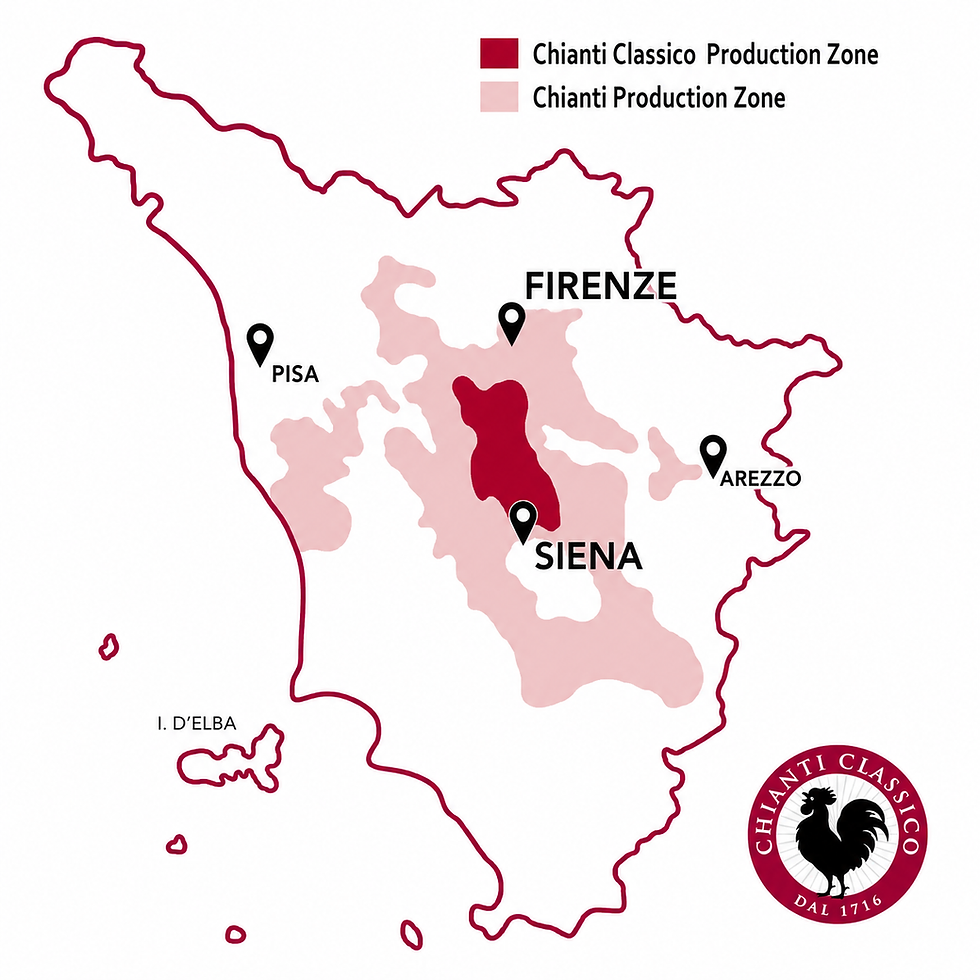
Neither denomination is “inside” the other in a legal sense—even though geographically the Chianti DOCG production area wraps around Chianti Classico.
Approximate map of the Chianti & Chianti Classico regions.
A Brief History
The story begins centuries ago.
Originally, the name Chianti referred to a relatively small hilly territory between Florence and Siena.
In 1716, Grand Duke Cosimo III de’ Medici issued an edict defining the boundaries of Chianti, along with several other important Tuscan wine-producing areas. This makes Chianti one of the earliest examples of a legally delimited wine-producing territory.
That historic Chianti territory forms the heart of what we today call Chianti Classico.
Over the following centuries, the popularity of Chianti wine exploded.
Wine was increasingly produced under the Chianti name outside the historic territory, and during the 20th century the official production zone was expanded considerably.
The word “Classico” was eventually used to distinguish the historic production area from the much larger surrounding Chianti zone.
Today, Chianti DOCG and Chianti Classico DOCG are two legally separate denominations.
The history of Chianti from 1716 until today.

Two Regions. Two Rule Books.
Two Regions. Two Rule Books.
This is where many people become confused.
Both denominations are based primarily on Sangiovese, but each has its own production regulations, geographical boundaries and classification system.
And in 2026, the differences became even greater.
Chianti DOCG
This is the larger production area.
It stretches across much of central Tuscany and is divided into eight recognised subzones:
Rufina
Montespertoli
Colli Fiorentini
Colli Senesi
Colli Aretini
Colline Pisane
Montalbano
Terre di Vinci
So a Chianti wine may simply say Chianti DOCG, or it may include one of these subzones on the label:
Chianti Rufina DOCG
Chianti Colli Senesi DOCG
Chianti Montespertoli DOCG
Etc.
Minimum Sangiovese:
60%
This is one of the most important changes introduced in 2026.
Previously, Chianti DOCG required a minimum of 70% Sangiovese. Under the new regulations, that has been lowered to:
60–100% Sangiovese
Other grape varieties authorized for cultivation in Tuscany may make up the remainder of the blend, subject to certain restrictions.
White grape varieties may account for a maximum of 10%, while Cabernet Sauvignon and Cabernet Franc together may generally account for no more than 15% of the blend.
So yes—despite being thought of as a red wine region, white grapes can still legally form part of a red Chianti DOCG blend.
What about ageing?
Unlike Chianti Classico, it is not really accurate to describe basic Chianti DOCG as having a simple “six-month minimum ageing” requirement.
Instead, the regulations establish earliest release dates, which vary according to the wine and subzone.
Basic Chianti DOCG, for example, can generally be released from 1 March following the harvest, while some subzones require later release.
Chianti Rosé
Another major change arrived in 2026:
Chianti Rosé DOCG is now an official category.
It must contain at least 60% Sangiovese and may be released from 1 December of the harvest year.
Interestingly, Rosé can also carry the name of one of the eight geographical subzones when it meets the relevant requirements.
Superiore and Riserva
Chianti may also carry the additional designations:
Chianti Superiore
and
Chianti Riserva
Superiore is not a geographical subzone. It is a production category with stricter requirements and a later release date.
Riserva requires a minimum of two years of ageing, calculated from 1 January following the harvest.
Chianti Classico DOCG
The Three Levels of Chianti Classico
There are three recognised categories:
Chianti Classico Annata
Minimum ageing: 12 months
Chianti Classico Riserva
Minimum ageing: 24 months, including at least 3 months in bottle
Chianti Classico Gran Selezione
Minimum ageing: 30 months, including at least 3 months in bottle
Gran Selezione has even stricter rules.
It must contain at least:
90% Sangiovese with the remaining maximum 10% coming only from permitted native Tuscan red grape varieties.
What about the 11 UGAs?
Chianti Classico does not have “subzones” in the same sense as Chianti DOCG.
Instead, the territory has been divided into 11 Unità Geografiche Aggiuntive (UGA):
Castellina
Castelnuovo Berardenga
Gaiole
Greve
Lamole
Montefioralle
Panzano
Radda
San Casciano
San Donato in Poggio
Vagliagli
These geographical indications are designed to give greater prominence to the individual territories within Chianti Classico.
However, there is an important detail:
At present, the UGA name may be used on the label for Chianti Classico Gran Selezione, not generally for Annata or Riserva.
So you might encounter a Chianti Classico Gran Selezione “Radda” or “Panzano”, for example.
And, of course, every bottle of Chianti Classico carries the famous Black Rooster (Gallo Nero).
The Quality Pyramids
This is perhaps the easiest way to understand the distinction.
Chianti DOCG
Chianti
Chianti Superiore
Chianti Riserva
Alongside these are the eight geographical subzones and, since 2026, the new Chianti Rosé category.
Chianti Classico DOCG
Chianti Classico Annata
Chianti Classico Riserva
Chianti Classico Gran Selezione
Notice something important:
These are two separate systems sitting side by side.
Chianti does not “become” Chianti Classico by increasing in quality or ageing for longer.
A Chianti Riserva is still Chianti DOCG.
A Chianti Classico Annata is still Chianti Classico DOCG.
They come from different legally defined territories and follow different rule books.
Can the Same Winery Produce Both?
Yes.
Some wineries own vineyards in both production areas.
If the grapes come from vineyards located within the Chianti Classico production zone and the wine follows its regulations, it may be labelled Chianti Classico DOCG.
If the grapes come from vineyards within the surrounding Chianti DOCG production area and follow those regulations, the wine may be labelled Chianti DOCG, potentially with one of its geographical subzones.
The important factor is where the grapes are grown and which denomination's regulations the wine follows, not simply where the winery building happens to be located.
Which One Is Better?
This is really the wrong question.
There are outstanding wines in both denominations.
Chianti Classico generally has:
a higher minimum percentage of Sangiovese
no white grapes permitted in the blend
longer minimum ageing before release
increasingly detailed geographical identification through the UGA system
But that doesn't mean that every Chianti Classico is automatically “better” than every Chianti.
Some of Tuscany’s most elegant and age-worthy Sangiovese wines come from Chianti DOCG subzones such as Rufina, while excellent producers throughout the wider Chianti denomination continue to produce wines of great character and quality.
The best advice?
Judge the producer and the individual wine—not simply the name on the label.
The quality pyramids of Chianti & Chianti Classico.

The Takeaway
The next time you see these names on a wine list, remember:
🍷 Chianti Classico is the historic heartland of Chianti.
🍷 Chianti is the much larger surrounding DOCG and now has eight geographical subzones.
🍷 Chianti DOCG now requires a minimum of 60% Sangiovese.
🍷 Chianti Classico requires at least 80% Sangiovese - or 90% for Gran Selezione.
🍷 Chianti Rosé DOCG became an official category in 2026.
🍷 Each denomination has its own regulations, classifications and identity.
And perhaps most importantly:
Chianti Classico is not a superior level of Chianti. They are two separate denominations.
Understanding that simple distinction makes reading Tuscan wine labels infinitely easier—and gives you a deeper appreciation of one of Italy’s most fascinating wine landscapes.
On our wine tours, we visit producers in both Chianti and Chianti Classico, allowing our guests to explore these differences directly in the vineyards and cellars where the wines are made.
This chart roughly explains the differences between the two regions.
On our wine tours we visit both Chianti and Chianti Classico, allowing guests to taste the differences directly from the producers themselves.


Comments