
Chianti Classico: The Heart of Tuscan Wine

Updated: Aug 4
If there is one wine region that captures the soul of Tuscany, it's Chianti Classico.
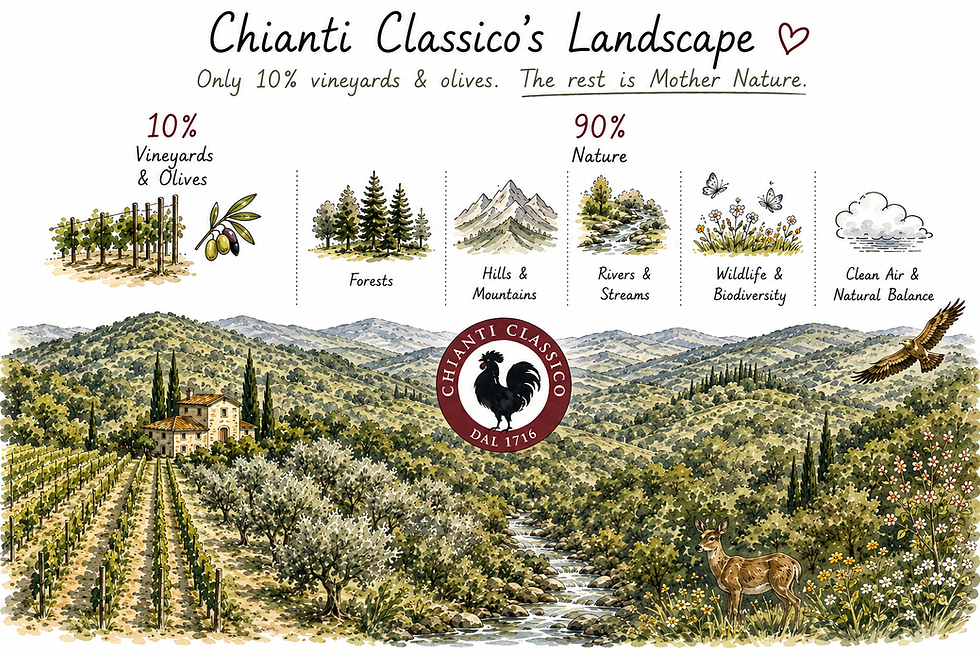
This is a landscape where vineyards weave between ancient oak forests, olive groves blanket the hillsides, and medieval villages seem almost unchanged by time. Every winding road between Florence and Siena reveals another stone farmhouse, another cypress-lined driveway, another vineyard climbing the slopes.
But Chianti Classico isn't simply beautiful.
It is one of the world's great wine regions.
For centuries, these hills have been devoted to growing Sangiovese, producing wines that are unmistakably Tuscan: vibrant, savoury, elegant and capable of ageing for decades.
Today, Chianti Classico is also one of Italy's most dynamic appellations. The region has embraced innovation without losing sight of its history, creating a unique quality pyramid, recognising eleven distinct geographical areas, and continuing to refine what many believe is the purest expression of Sangiovese.

A Wine Region Born Long Before Italy
Long before Italy existed as a unified country, the rolling hills between Florence and Siena were already recognised for producing exceptional wine.
The name Chianti originally referred not to a wine, but to a mountainous and heavily forested area stretching across central Tuscany.
By the Middle Ages, this territory had become strategically important. Florence and Siena were fierce rivals, constantly competing for power, trade and influence. Between them lay a rugged landscape dotted with castles, fortified villages and vineyards.
To help defend this frontier, Florence established the Lega del Chianti (League of Chianti), a military alliance centred around three communities:
Radda in Chianti
Gaiole in Chianti
Castellina in Chianti
These villages formed the historic heart of Chianti Classico, and more than seven centuries later they remain at its core.
Their emblem?
A proud black rooster.

The Legend of the Black Rooster
No symbol is more closely associated with Chianti Classico than the Gallo Nero, the Black Rooster.
You'll find it on bottles, winery signs, flags, tasting rooms and souvenir shops throughout the region. Today it serves as the emblem of the Consorzio Vino Chianti Classico, but its origins lie somewhere between history and legend.
According to tradition, during the Middle Ages the rival city-states of Florence and Siena were constantly at odds over the borders between their territories. Rather than continue fighting, they agreed on an unusual solution.
At the first crow of a rooster, one knight would leave Florence while another departed from Siena. Wherever the two horsemen met would become the new frontier.
The Sienese chose a magnificent white rooster, feeding it generously so it would be strong for the journey.
The Florentines, on the other hand, selected a scrawny black rooster and kept it hungry. At dawn, eager for breakfast, the poor bird began crowing long before sunrise.
The Florentine knight gained a considerable head start and met his Sienese counterpart just outside Siena itself, securing a much larger territory for Florence.
Whether the story is true or not hardly matters.
The Black Rooster became the enduring symbol of the Chianti region and, centuries later, was adopted by the Consorzio Vino Chianti Classico as the official emblem of the appellation.
Today, spotting the Black Rooster on a bottle is one of the easiest ways to recognise a Chianti Classico.

The Man Who Gave Chianti Its Identity
If the Black Rooster gave Chianti Classico its symbol, Barone Bettino Ricasoli gave it its identity.
Known as the "Iron Baron," Ricasoli inherited the imposing Castello di Brolio after years of political turmoil. While he would later become Italy's second Prime Minister, one of his greatest legacies was not political at all—it was viticultural.
Obsessed with improving the wines produced on his estate, Ricasoli spent decades experimenting with grape varieties, vineyard practices and blending proportions.
In 1872, he wrote a famous letter describing what he believed to be the ideal composition of a Chianti wine.
His formula placed Sangiovese firmly at the centre, using Canaiolo to soften its naturally firm tannins, while a small proportion of white grapes—primarily Malvasia—made the wine more approachable in its youth.
It was never a legal recipe, but it became enormously influential. For generations, producers looked to Ricasoli's work as the benchmark for Chianti.
Ironically, modern Chianti Classico has come almost full circle.
Today, white grapes are no longer permitted in Chianti Classico, and most producers rely overwhelmingly on Sangiovese, often using little or no blending at all. Yet Ricasoli's central insight—that Sangiovese is the soul of Chianti Classico—has never been more relevant.
The Black Rooster Today
The Black Rooster isn't just a reminder of a medieval legend—it remains an important guarantee of authenticity.
Since 2005, every bottle of Chianti Classico must display the Gallo Nero logo, either on the neck capsule or the back label. It's the easiest way to distinguish a genuine Chianti Classico from the broader Chianti appellation.
The symbol is managed by the Consorzio Vino Chianti Classico, founded in 1924 by a small group of producers determined to protect the identity and reputation of the region.
Today, the Consorzio represents hundreds of wineries and continues to oversee promotion, research and quality standards, helping Chianti Classico remain one of Italy's most respected wine appellations.
For visitors, spotting the Black Rooster has become second nature.
If it's there, you're holding a bottle from the historic heart of Chianti.
A Region Built Around Sangiovese
Walk through enough vineyards in Chianti Classico and one thing quickly becomes obvious.
Everything revolves around Sangiovese.
The grape has found an almost perfect home in these hills, where elevations typically range between 250 and 600 metres, summers are warm but rarely extreme, and cool nights help preserve freshness and aromatic complexity. The combination of altitude, rolling hills and significant day-to-night temperature variation allows Sangiovese to ripen slowly and evenly, developing ripe fruit without losing its vibrant acidity.
But climate is only half the story.
Beneath the vineyards lies an extraordinary geological patchwork that gives Chianti Classico many of its distinctive personalities.

Galestro or Alberese?
Ask two Chianti Classico winemakers about soils and you'll almost certainly hear two words repeated over and over again:
Galestro and Alberese.
These are the two geological signatures of the region.
Galestro is a brittle, flaky, schist-like rock that breaks apart easily. It drains well, encourages vines to root deeply, and is often associated with elegant, fragrant wines showing bright acidity and fine tannins.
Alberese, by contrast, is a compact limestone-rich marl. It tends to retain moisture slightly better while still offering excellent drainage, often producing wines with more structure, concentration and firm tannins. Around Castellina in Chianti, Alberese is particularly common and has become almost synonymous with the area's style.
Of course, nature is never that simple.
Most vineyards contain a mixture of soil types, while altitude, slope, exposure and local climate all play equally important roles. It's this endless combination of variables that explains why two wineries only a few kilometres apart can produce remarkably different expressions of Sangiovese.
Perhaps that's why Chianti Classico has never been easy to define.
And perhaps that's exactly what makes it so fascinating.

There's Also a Sweet Side
When people think of Chianti Classico, they naturally think of red wine.
But the appellation also produces one of Tuscany's most traditional dessert wines: Vin Santo del Chianti Classico DOC.
Made from carefully selected white grapes—primarily Trebbiano Toscano and Malvasia Bianca Lunga—the bunches are traditionally dried for several months before pressing. The wine then spends years ageing in small wooden barrels known as caratelli, often in the attics of wineries where seasonal temperature changes slowly shape its character.
The result is a beautifully complex wine with notes of dried apricot, honey, toasted nuts and orange peel, balanced by a remarkable freshness.
Served with cantucci biscuits, Vin Santo remains one of Tuscany's most iconic endings to a meal—and a reminder that Chianti Classico is about far more than red wine.

Three Wines, One Appellation
Unlike almost every other Italian wine region, Chianti Classico has developed a remarkably clear quality hierarchy.
Each level builds on the previous one, not only through longer ageing requirements but also through increasing vineyard selection and ambition.
Chianti Classico Annata
This is the wine most people encounter first.
Fresh, vibrant and unmistakably Sangiovese, Annata is designed to express the vintage rather than extended ageing. Red cherry, violets, herbs and lively acidity make it wonderfully versatile at the table.
Don't mistake "entry level" for simple.
Many producers consider their Annata the purest expression of both the vintage and their house style.
Chianti Classico Riserva
Riserva takes another step forward.
Only wines judged worthy by the producer are selected for longer ageing, resulting in greater complexity, more integrated tannins and deeper savoury flavours.
With extra time in barrel and bottle, aromas begin to evolve from fresh cherries towards dried flowers, tobacco, leather and forest floor, while still retaining the bright acidity that defines great Sangiovese.
A well-made Riserva often strikes a beautiful balance between youthful energy and mature elegance.
Chianti Classico Gran Selezione
Introduced with the 2014 vintage, Gran Selezione represents the highest tier of the appellation.
The rules are stricter.
The grapes must come exclusively from the winery's own vineyards, rather than purchased fruit, allowing producers complete control over every stage of production.
For many estates, Gran Selezione has become an opportunity to showcase their finest vineyards, oldest vines or exceptional parcels.
The category has not been without debate. Some critics questioned whether another classification was necessary, while others argued it finally gave Chianti Classico a top tier comparable to the great wines of other prestigious regions.
A decade later, most agree that Gran Selezione has encouraged producers to think even more carefully about site, terroir and vineyard identity.
Which brings us to one of the biggest changes in the history of Chianti Classico...
The recognition that not all parts of the region are the same.

UGA - Unità Geografica Aggiuntiva

One Region, Eleven Personalities
For many years, every bottle of Chianti Classico simply said "Chianti Classico."
Whether the grapes came from the cool forests around Radda, the windswept vineyards of Lamole or the warmer hills of Castelnuovo Berardenga, the label gave no clue.
Wine lovers knew there were differences.
The bottles just didn't tell you.
That changed with the 2021 vintage, when producers were finally allowed to include one of eleven Unità Geografiche Aggiuntive (UGAs) on bottles of Gran Selezione.
Think of them as official geographical identities within Chianti Classico.
They're not quality levels—every UGA can produce outstanding wines. Instead, they acknowledge that the historic Chianti Classico territory is far too diverse to be described as a single place.
Climate, altitude, soils and exposure vary enormously across the region, and so do the wines.
The UGA system allows producers to celebrate those differences rather than blend them away.
Different places and expressions of Sangiovese
Although each UGA has its own character, it's worth remembering that no two producers make identical wines. A winemaker's philosophy, vineyard management and cellar decisions are just as important as geography.
Still, certain patterns have emerged over time.
San Casciano
The northern gateway to Chianti Classico.
Closest to Florence, San Casciano generally enjoys a slightly milder climate and lower elevations. The wines are often generous and approachable, combining ripe fruit with elegant tannins.
Greve
Perhaps the most varied of all the UGAs.
Altitude changes dramatically from one end of the commune to the other, producing everything from rich, structured wines to delicate, high-elevation expressions. There is no single "Greve style," which is precisely what makes it so fascinating.
Montefioralle
One of the smallest UGAs.
Centred around a beautifully preserved medieval hamlet, Montefioralle produces limited quantities of refined, elegant wines that often display remarkable finesse.
Lamole
If one UGA has become synonymous with elegance, it's Lamole.
Among the highest vineyards in Chianti Classico, many sit above 500 metres. Cooler temperatures and sandstone-rich soils produce wines that are floral, perfumed and wonderfully graceful, often with bright acidity and silky tannins.
Many enthusiasts consider Lamole one of Tuscany's most distinctive terroirs.
Panzano
A natural amphitheatre of vineyards.
Protected by surrounding hills and benefiting from excellent exposure, Panzano often produces powerful yet beautifully balanced wines. The combination of sunshine, elevation and the famous Galestro soils gives Sangiovese impressive depth without sacrificing freshness.
Radda
Cool, forested and elevated.
Radda is one of the highest and coolest parts of Chianti Classico. The wines tend to be vibrant, finely structured and long-lived, with pronounced acidity and an almost Burgundian sense of elegance.
For lovers of classic Sangiovese, Radda is often considered the benchmark.
Gaiole
One of the largest and most diverse UGAs.
Its vineyards stretch through wooded valleys and rolling hills, producing wines with impressive structure, dark fruit and excellent ageing potential. Gaiole often rewards patience.
Castellina
Historic vineyards and classic limestone-rich soils.
Castellina combines Alberese and Galestro with moderate elevations to produce beautifully balanced wines, where ripe fruit, savoury notes and firm but polished tannins come together in harmony.
Vagliagli
One of the newest names for many wine lovers.
Located east of Siena, Vagliagli is gaining recognition for wines that combine generous fruit with freshness and precision. It remains something of a hidden gem.
Castelnuovo Berardenga
The southernmost UGA.
Warmer temperatures generally lead to fuller-bodied wines with darker fruit, broader tannins and impressive richness. Yet the best examples retain the freshness that defines great Chianti Classico.
San Donato in Poggio
A small but historic area characterised by rolling hills and mixed soils.
Its wines often sit somewhere between the elegance of the northern communes and the power found further south, offering remarkable balance and versatility.

A New Way of Thinking About Chianti Classico
The introduction of the UGAs wasn't about creating another quality hierarchy.
It was about recognising that place matters.
For decades, Burgundy lovers have spoken about villages and vineyards. Barolo enthusiasts debate the merits of Serralunga versus La Morra.
Chianti Classico is now telling a similar story.
Not that one area is better than another—but that each has its own voice.
As you taste your way through the region, you'll begin to notice those voices.
Some wines are floral and almost weightless.
Others are earthy, powerful and deeply structured.
All of them are unmistakably Chianti Classico.
A Region That Never Stands Still
It's easy to think of Chianti Classico as a region defined by tradition.
After all, many wineries have been making wine for centuries, castles still overlook the vineyards, and Sangiovese remains at the heart of every bottle.
But spend a little time talking to the people who make the wine, and you'll discover something different.
Chianti Classico is constantly evolving.
Over the past thirty years, producers have transformed the region. Vineyards have been replanted with carefully selected Sangiovese clones, lower yields have become the norm, and a deeper understanding of individual vineyard sites has led to wines that express their origins more clearly than ever before.
Many estates have also embraced organic and regenerative farming, recognising that healthy soils and thriving biodiversity are essential to producing great wines for generations to come.
Even in the cellar, styles continue to evolve.
The heavily extracted, oak-driven wines that were fashionable in the 1990s have largely given way to a more restrained approach. Today, many winemakers favour gentler extraction, larger oak casks or well-integrated French barrels, allowing Sangiovese itself to remain the star of the show.
The result?
Modern Chianti Classico is fresher, more elegant and more transparent than ever before.
Rather than trying to impress with sheer power, the best wines speak quietly but confidently of where they come from.

Visiting Chianti Classico
One of the greatest pleasures of visiting Chianti Classico is discovering that it isn't a destination with a single centre.
Instead, it's a collection of villages, winding country roads, forests and vineyards spread across nearly 70,000 hectares between Florence and Siena.
Take your time.
Stop in the villages.
Each has its own personality.
Greve buzzes with cafés and wine shops around its triangular piazza. Castellina invites you to stroll along its medieval covered walkway, while Radda feels almost untouched, perched high among forests and vineyards. Further south, Gaiole offers a quieter, more rural atmosphere, and Castelnuovo Berardenga begins to hint at the landscapes of the Crete Senesi.
Of course, the real magic lies beyond the villages.
Some of my favourite memories aren't from famous estates at all, but from sitting at a kitchen table with a winemaker, tasting straight from the barrel while talking about the vintage, the weather and life in Chianti.
Those are the moments that stay with you.
✏️ Rebecca's Field Notes
People often ask me which winery is "the best."
I honestly don't think there is one.
Some of my favourite visits are at estates that produce fewer than 20,000 bottles a year. Others are historic names that have helped shape the reputation of the region.
What matters most isn't the size of the winery—it's the people behind it.
If you find a passionate producer who loves sharing their work, you've already found a great winery. That's the kind of places we aim to bring our guests to on our Grape Tours!
So... Which Chianti Classico Should You Buy?
If you're just beginning your journey, start with an Annata.
It will introduce you to the bright cherry fruit, savoury herbs and vibrant acidity that define the region.
If you're looking for something with more depth and complexity, explore a Riserva.
And if you want to experience how profoundly Sangiovese can express a particular place, seek out a Gran Selezione, especially one that proudly names its UGA on the label.
Then do something even better.
Buy two bottles from different parts of Chianti Classico.
Open them side by side.
You may be surprised that the same grape, grown only a few kilometres apart, can tell two completely different stories.
That's the magic of Chianti Classico.
Rebecca's Rabbit Hole 🐇

Why Is There a Black Rooster on Olive Oil Too?
The famous Gallo Nero doesn't simply identify Chianti Classico wine—it represents the entire historic Chianti Classico territory.
That means producers within the appellation can also make Chianti Classico DOP Extra Virgin Olive Oil, using olives grown inside the same hills that produce the region's vineyards.
Just like the wines, the olive oil must follow strict production rules and pass quality controls before it can display the green Black Rooster seal.
So when you spot that green rooster on a bottle of olive oil, you're looking at the same protected landscape—only in liquid gold instead of red wine.
🍷 Continue Your Tuscan Wine Journey
If you enjoyed this deep dive into Chianti Classico, here are a few more articles you might like:

🍇 Sangiovese: Tuscany's Signature Grape
Chianti Classico wouldn't exist without Sangiovese. Discover the history, local names, clones and why Italy's most famous red grape tastes so different from one region to another.
→ Read: The Many Faces of Sangiovese

🏛️ Chianti vs Chianti Classico: What's the Difference?
They share a name, but they're not the same wine. Learn how two neighbouring appellations evolved, why the Black Rooster matters, and how to tell them apart.
→ Read: Untangling the Chianti Confusion

🏷️ Understanding Italian Wine Classifications
DOC, DOCG, IGT, Riserva, Gran Selezione... Italian wine labels don't have to be confusing. This guide explains what each term really means and how to choose wine with confidence.


Comments