San Gimignano's Wines: More Than Just Vernaccia
- Rebecca Gouttenoire
- 1 day ago
- 4 min read

When most people think of San Gimignano, they picture its medieval towers rising above the Tuscan countryside. Others know it for its famous white wine, Vernaccia di San Gimignano.
But what many visitors don't realize is that this little hilltop town is home to different wine appellations, the most important and historic white grape produces an aged-worthy white wine, and then a suprising denomination producing diverse varietal wines everything Sangiovese to Cabernet Sauvignon, and then Vin Santo - and just to add to the confusion this area also is in Chianti so could even produce the sub-denomination Chianti Colli Senesi (this is something you can read more about here)
Let's uncork the story.


Vernaccia di San Gimignano DOCG
Tuscany's white wine that loves to grow old
Vernaccia is unlike almost every other Tuscan white wine.
Most Italian white wines are crafted to be enjoyed young while they're bursting with citrus and floral aromas. Vernaccia, however, is one of those rare exceptions that can become even more fascinating with age.
Young bottles typically show notes of:
lemon
white flowers
green apple
crisp minerality
Give an excellent bottle a decade or more, and you'll discover something entirely different:
honey
chamomile
toasted almond
saffron
flinty minerality
It's proof that white wines don't always have to be drunk immediately.

Italy's pioneering white
Vernaccia also occupies a unique place in Italian wine history.
It became:
🥇 Italy's first DOC wine (1966)
🥇 Italy's first white DOCG wine (1993)
Long before modern appellation laws existed, Vernaccia was already famous throughout Europe.
The poet Dante Alighieri mentioned it in the Divine Comedy, while Michelangelo famously described it as a wine that:
"It kisses, licks, bites, pricks and stings."
Not bad praise from two of Italy's greatest cultural icons.
Annata or Riserva?
The DOCG is beautifully simple.
Vernaccia di San Gimignano DOCG
minimum 85% Vernaccia di San Gimignano
the remaining grapes must be authorised white varieties
Annata
The standard version is made over the winter following harvest and is generally released in the spring, highlighting Vernaccia's freshness and lively acidity.
Riserva
Produced only in the best vintages, the Riserva must age for at least one year before release. With time, the wine gains remarkable complexity while maintaining its signature mineral backbone.

But wait... San Gimignano also makes red wine!
Many visitors are surprised to learn that Vernaccia DOCG is only half of the story.
Alongside it exists San Gimignano DOC, a denomination dedicated almost entirely to red wines.
The DOC includes:
Rosso
Sangiovese
Cabernet Sauvignon
Merlot
Syrah
Pinot Nero
Each of these can also be produced as Riserva.
The denomination also allows producers to make:
Rosato
Vin Santo
Vin Santo Occhio di Pernice
So while the town has become synonymous with white wine, there's a much broader winemaking tradition waiting to be explored.
Why Vernaccia deserves a place on your table
For many visitors, Vernaccia is simply the first glass they enjoy while admiring the towers of San Gimignano.
For us, it's much more than that.
It's a wine that challenges the common belief that Italian white wines should always be drunk young. It combines centuries of history with remarkable ageing potential and offers one of Tuscany's most distinctive expressions of terroir.

Why San Gimignano is worth exploring
San Gimignano as one of Tuscany's most well-preserved medieval villages hasn't got the reputation of being off the beaten track, but it's so beautiful and interesting with delicious products like its wine, olive oil and saffron that it really does deserve a visit.
Next time you consider exploring San Gimignano, make sure to join us on a wine tour (small group tours 2 weekly departures from Florence, or private tours)

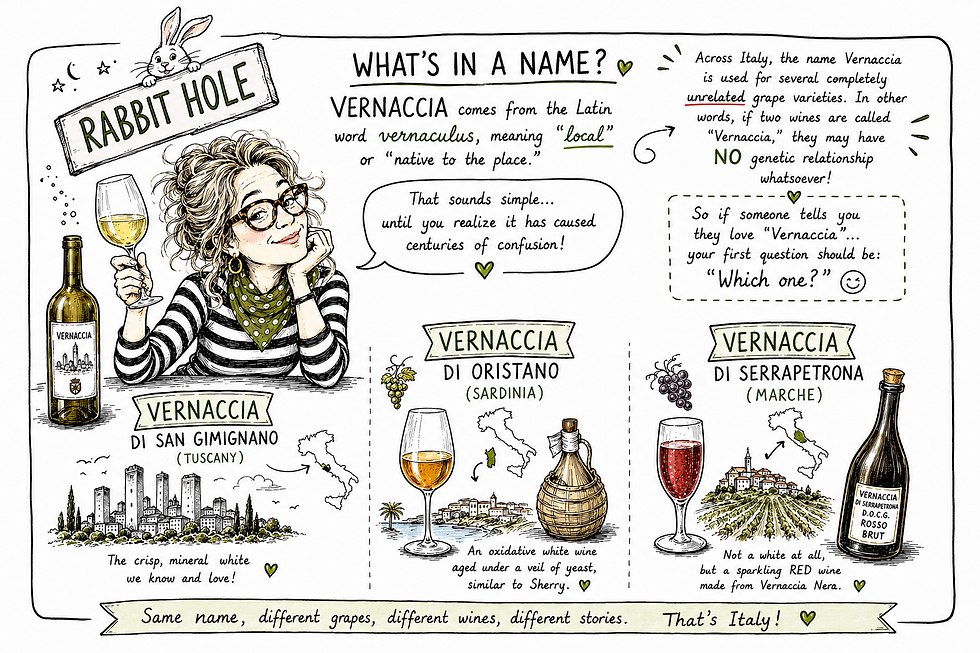
🐇 Rebecca's Rabbit Hole: What's in a Name?
The name Vernaccia comes from the Latin word vernaculus, meaning "local" or "native to the place."
That sounds simple enough... until you realize it has caused centuries of confusion!
Across Italy, the name Vernaccia is used for several completely unrelated grape varieties. In other words, if two wines are called Vernaccia, they may have no genetic relationship whatsoever.
Some famous examples include:
🍷 Vernaccia di San Gimignano (Tuscany) – the crisp, mineral white we've been talking about.
🍷 Vernaccia di Oristano (Sardinia) – an oxidative white wine aged under a veil of yeast, with similarities to Sherry.
🍷 Vernaccia di Serrapetrona (Marche) – not a white at all, but a sparkling red wine made from the Vernaccia Nera grape.
So if someone tells you they love "Vernaccia"... your first question should be: "Which one?" 😉