
The Tuscan Fiasco: The Bottle That Became a Disaster

Updated: Sep 22

Recently I went to a small private museum in a medieval tower, dedicated entirely to a bottle.
Admittedly, not just any bottle.
The Tuscan fiasco. That wonderfully round glass flask wrapped in straw that, for generations, was practically synonymous with Chianti.
I had seen hundreds of them before. Ever since I got to Tuscany, it's curious fiasco was probably one of the most recognizable objects found in every trattoria and souvenir shop.
But seeing the history of the fiasco laid out in front of me, examples stretching back through centuries, photographs of the people who made them, and the different ways the straw covering evolved, made me realize that I had never really thought about the bottle itself had evolved.
And it turns out that the humble fiasco has quite a story.
There are glassmakers, medieval wine drinkers, government regulations, thousands of Tuscan women, horses pulling enormous loads of wine, international exports and, eventually, one of the strangest linguistic transformations imaginable.
Because, of course, there's one other small problem with the word fiasco.
In English, it means a complete disaster.
How on earth did a Tuscan wine bottle manage that?
But let's start with the bottle.

Before the Fiasco Became Chianti
The fiasco is much older than the image most of us have of Chianti.
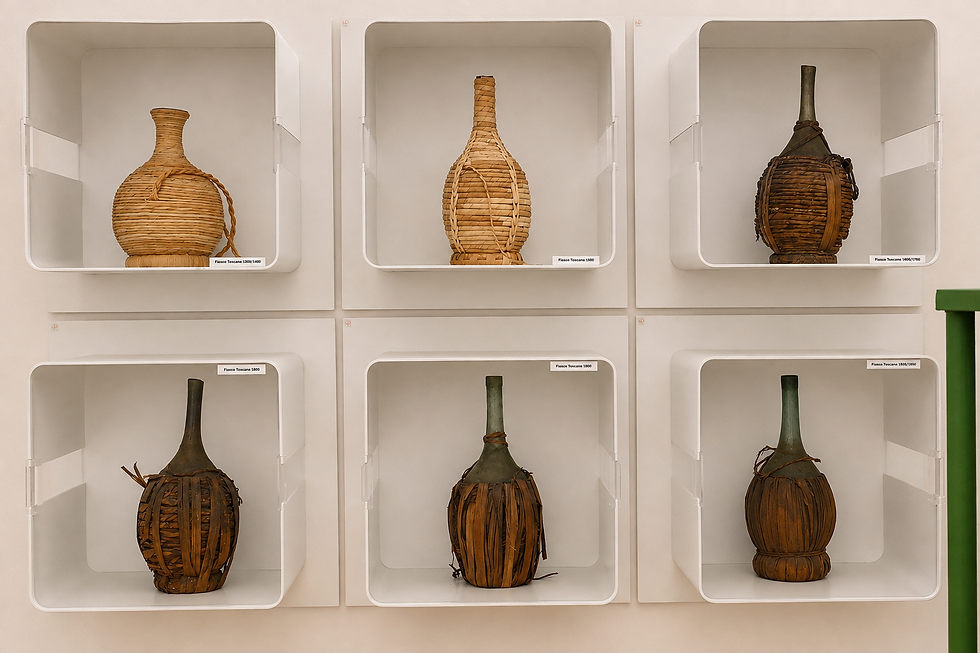
Its history reaches back into medieval Tuscany. The chronology in the museum material places the first straw-covered fiaschi around the 1300s, with glassmakers producing them in Tuscany by the following century.
We also know that the word itself is medieval.
Giovanni Boccaccio, born in 1313, mentions the fiasco in his writings, so by the fourteenth century it was clearly already a familiar object.
And it wasn't necessarily filled with Chianti.
The fiasco was simply a practical container for liquids, particularly wine and oil, at a time when glass bottles were handmade, relatively fragile and considerably more precious than the disposable objects we think of today.
Which brings us to the straw.
Why the Straw?
Today we look at the straw covering and see decoration.
Originally, it was anything but.
A traditional fiasco was made from relatively thin blown glass with a rounded body. The covering protected that glass from knocks and bumps, made the bottle easier to handle and transport and, importantly, gave its rounded bottom something to stand on.
In other words, the straw wasn't there to make the bottle look Tuscan.
It was packaging technology.
And quite clever packaging technology at that.
The material traditionally used wasn't necessarily wheat straw as we might imagine today, but marsh grasses and other plant materials that were cheap, flexible and readily available.
Over the centuries, the covering itself changed.
Looking at historical fiaschi side by side, you can see different techniques: elaborate horizontal weaving, vertical strips, reinforced bases and increasingly simplified coverings as production became larger and more industrialized.
What we now think of as one iconic bottle was actually evolving all the time.
A Bottle You Could Trust
The fiasco became so widely used that its capacity eventually had to be regulated.
This is one of my favourite details.
In Tuscany, the fiasco wasn't only a type of bottle. It could also be a unit of measurement.
Historical regulations attempted to make sure that when you bought a fiasco of wine, you actually received the amount you were paying for.
In 1574, measures were introduced involving an official mark to guarantee the capacity of the fiasco. Further controls followed: another official seal was attached to the covering in 1579, and by 1629 a glass seal could be applied to the neck of the bottle.
Long before the modern wine label told us appellation, alcohol percentage and bottle volume, authorities were already worrying about whether your fiasco contained the right amount of wine.
Some things in the wine business never change.

The Women Who Dressed the Fiaschi
And this is perhaps my favourite part of the story.
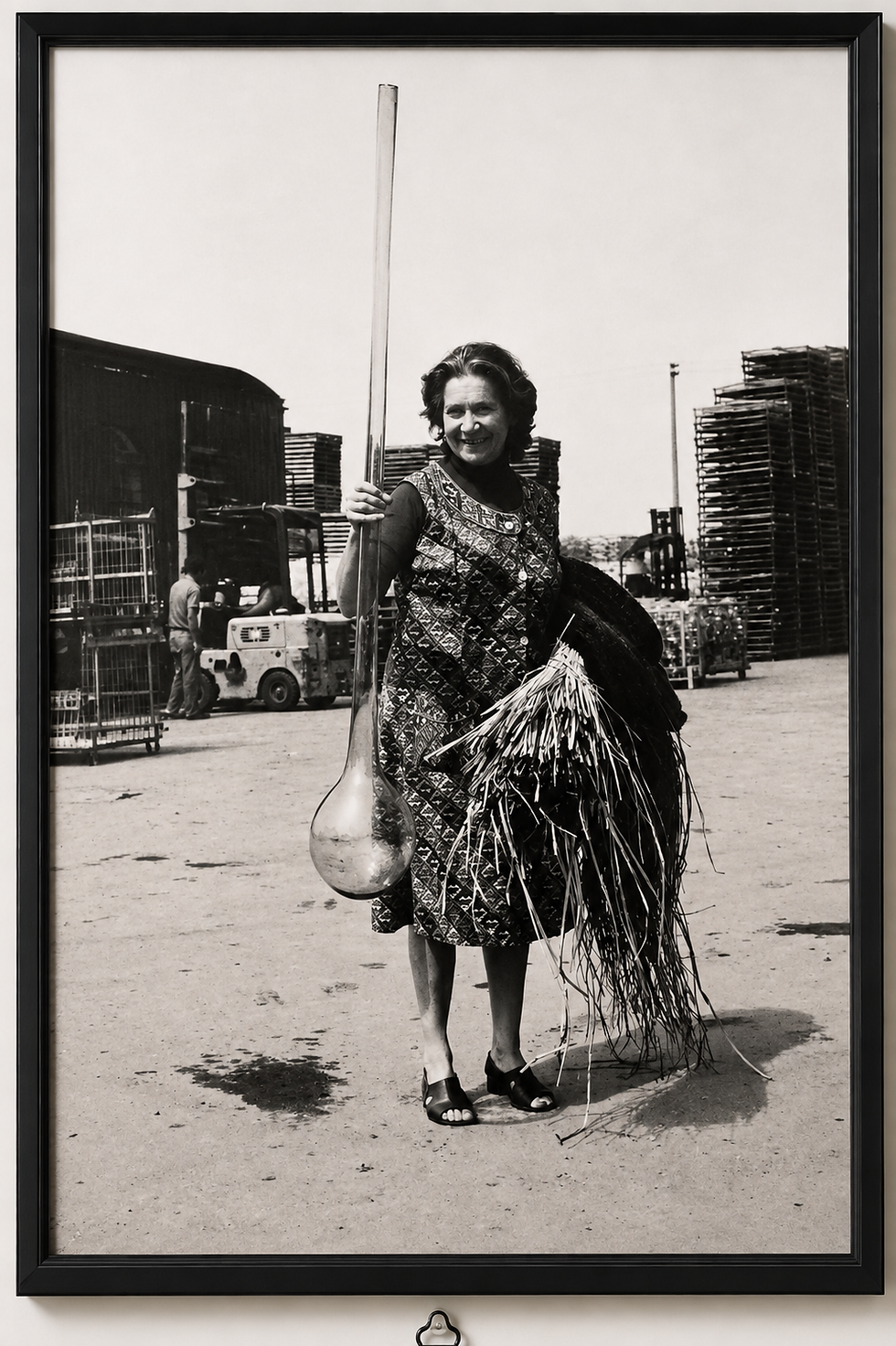
Someone had to put all that straw around all those bottles.
And very often, that someone was a woman.
They were known as the fiascaie.
In the great glass-producing areas around Empoli and the Valdelsa, dressing fiaschi became an important occupation for generations of women.
This wasn't simply somebody casually winding a bit of straw around a bottle.
It was skilled, repetitive manual work, and it became an important part of the local economy. Women could work in workshops, but much of the work was also carried out at home, making the fiasco part of domestic life as well as industrial life.
At the height of the industry there were thousands of fiascaie in this part of Tuscany — around 5,000 women, according to the history I was given at the museum.
Think about that for a moment.
Thousands of women, bottle after bottle after bottle, creating by hand the object that would eventually become one of the most recognizable symbols of Italian wine in the world.
Their work was so important that the fiascaie also became part of the history of women's labour in the area. In Empoli alone, historical sources record around 1,800 fiascaie during the first half of the twentieth century.
And this history isn't as distant as it sounds.
Some of the last women who had actually worked as fiascaie lived to almost 100 years old and died only very recently.
The medieval-looking craft survived within living memory.
I find that rather extraordinary.

When a Fiasco Became CHIANTI
The fiasco existed long before it became inseparable from Chianti.
But eventually the two images merged.
As Tuscan wine production and export grew, the practical local flask became the package through which much of the world encountered Chianti.
There are wonderful old photographs showing enormous quantities of fiaschi packed tightly together for transport. One photograph in the museum material shows filled fiaschi stacked onto a horse-drawn cart — a method apparently still being used as late as 1935.
This was no quaint little artisanal sideline.
The fiasco was serious commercial packaging.
And as Chianti travelled, so did the bottle.
By the twentieth century, especially after the Second World War, the straw-covered fiasco had become an international shorthand for Italian wine.
You didn't even need to read the label.
Round bottle + straw = Chianti.
And then something rather unfortunate happened.

The Fiasco Became a Cliché
Success can be dangerous.
As huge quantities of inexpensive Chianti were exported around the world, the fiasco gradually changed from a symbol of Tuscany into a symbol of cheap Italian wine.
It appeared in pizzerias and trattorias everywhere.
And once the wine had been drunk, nobody threw away such a wonderfully Italian-looking bottle.
So we stuck candles into them.
Wax dripped down the sides.
Restaurants decorated shelves with them.
The fiasco became part of an international fantasy of Italy: red-and-white checked tablecloths, spaghetti, candles, accordions and Chianti in straw bottles.
Charming?
Absolutely.
But perhaps not the image you want when you're trying to convince the world that Chianti can also be a serious, age-worthy fine wine.
As producers increasingly focused on quality and on repositioning Chianti in international markets, the fiasco gradually lost its dominance to the straight-sided glass bottles we see today.
The bottle that had helped make Chianti recognizable around the world had eventually become an image that Chianti needed to escape.
Which is, when you think about it...
a bit of a fiasco.

Speaking of Which...
We need to talk about the word.
Because Italians still use fiasco to mean the bottle.
But they also have the expression:
fare fiasco
To fail.
And from that expression, the word travelled into other European languages.
By the nineteenth century, fiasco was being used in French and German in the sense of a failed performance. English adopted it around the middle of the nineteenth century, initially particularly in connection with theatrical or musical failure.
Eventually, English no longer needed the fare.
A failure simply became:
a fiasco.
But why?
Why should a perfectly useful glass bottle mean failure?
Welcome to the rabbit hole.
How Did a Bottle Become a Disaster?
There are several explanations.
One story involves glassblowers.
According to this theory, if a glassblower attempted to create something elaborate and the work went wrong, the failed piece could still be turned into a humble flask.
The masterpiece had become...
a fiasco.
It's wonderfully convincing.
Unfortunately, that doesn't necessarily make it true.
Another, even better story involves the seventeenth-century Italian comic actor Domenico Biancolelli.
The story goes that Biancolelli was famous for improvising comic monologues around objects.
One evening he appeared on stage carrying a fiasco and based his performance around it.
The audience didn't laugh.
The routine was a complete failure.
And thus he had, quite literally...
fatto fiasco.
It's almost too perfect.
Which is probably why we should be suspicious of it.
There are still other theories, including one involving a Florentine game in which the loser had to pay for the fiasco of wine.
The truth?
Nobody really knows.
Etymologists agree that the figurative Italian expression fare fiasco is the source of our modern meaning, but exactly why a flask became associated with failure remains uncertain.
And frankly, I rather like it that way.
A little mystery seems appropriate for a bottle that has been around for centuries.

And While We're Talking About Language...
Italian gives us another lovely expression:
prendere fischi per fiaschi
Literally, to mistake fischi — whistles — for fiaschi.
In other words, to completely misunderstand one thing for another.
The expression plays on the similarity of the two words, and it's still used today.
The humble fiasco has apparently been causing linguistic trouble for quite some time.

From Packaging to Tuscan Icon
What struck me most at the museum wasn't really the age of the bottles.
It was how much history could be contained in such an ordinary object.
The fiasco began as a practical solution.
Thin glass needed protecting, so people wrapped it in inexpensive plant material.
That simple solution became an industry.
The industry provided work for thousands of women.
The bottle became associated with Tuscan wine.
Tuscan wine travelled around the world.
The fiasco became a symbol of Chianti.
The symbol became a cliché.
And eventually the cliché became nostalgic again.
Today, when we see an old fiasco, we tend to smile.
It looks wonderfully retro. Wonderfully Tuscan. Perhaps slightly kitsch.
But after looking at those old bottles and photographs, I don't think I'll ever see one in quite the same way again.
Because wrapped around that little glass flask is a surprisingly large piece of Tuscan history.
Glassmakers.
Wine merchants.
Government seals.
Horse-drawn carts.
Chianti.
Exports.
And thousands upon thousands of women's hands weaving straw around glass.
All contained in one little bottle.
A fiasco.
And, for once, I mean that in the nicest possible way.


Comments